Showing posts with label 1934 - 1938. Show all posts

Tuesday, January 5, 2021

Kristallnacht in Chemnitz

Dearest grandchildren,

Thirty-one years ago, on November 9th, 1989, my twins Alex and Kat, were born in Oceanside, California. At the exact same time, across the world, the Berlin Wall was falling.

“Finally, Dad said, “GOOD things happen on November 9th!” 

At that time, I knew very little about my father’s early life, let alone the meaning for him of November 9th. He describes it here:

November 9th was a Nazi holiday to commemorate the Beer Hall Putsch of 1923. The date has meanwhile entered history for even more sinister reasons. On the night of November 8-9, 1938, many Jewish homes were ransacked, possessions looted or trashed, and the owners arrested. It became known as Reichskristallnacht , or the “Night of Broken Glass.” On that night, the display windows in many Jewish businesses were smashed, and practically every synagogue in Germany was set on fire. “The German People’s hatred of the vicious baiting of Germany by the International Jewry became spontaneously fanatic” the Nazis publicly said. (The word “fanatic” had always been derogatory; until the Nazis made it heroic!) In reality, the “public outburst” was completely planned and coordinated nationwide long in advance. But the day before, conveniently, a Nazi in France had been killed by a Jew. So the whole nationwide act of arson could nicely be made to look like a “spontaneous outburst of the enraged German population!”

We knew better. Our house was located directly across the street from the Chemnitz synagogue on Stephansplatz, and every important  room looked directly onto it.

Chemnitz synagogue

This probably could have been taken from the front room of the Heumann’s house. What a beautiful and sacred building!

Thank you, EBay. (I think I’ll bid on this postcard!) The copy says: “Antique Postcard. Postmarked in 1903.The Liberal Synagogue on Stephanplatz on the Kassberg, formerly the center of Jewish life in Chemnitz. Founded in 1871, the modern community consecrated a prayer hall (on Neugasse) in 1878 and an actual synagogue (on Stephansplatz) in 1899; the Liberal synagogue, built in the Romanesque style, featured a cupola and a seating capacity of 700. In March 1933, SA men forced Chemnitz Jews to remove anti- Nazi slogans from buildings and pillars, soon after which, on April 1, 1933, the anti-Jewish boycott was implemented in Chemnitz. Violence erupted, and some Jewish-owned stores were damaged. In October 1938, 300 Polish Jews were expelled from Chemnitz. On the evening of November 9, 1938 (Kristallnacht, Night of Broken Glass or November Pogrom), SA men and local youths set the synagogue on fire, cheered on by a shouting mob. Jewish-owned stores were looted, windows were smashed and more than 170 local Jews were arrested and taken to Buchenwald. Of these, one was shot, and a few died either during or after their detention. The synagogue was "sold" in April 1939.”

Chemnitz synagogue with cark for H house

Here’s another view, with the location of the Heumann house circled.

IMG_1210     IMG_1197

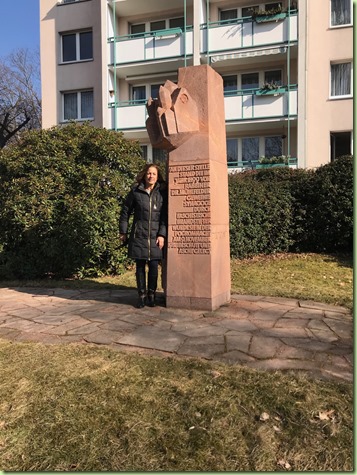
This monument (that’s my cousin, Claudia) is all that’s left at the location of that gorgeous synagogue. It’s heartbreaking. 

My mother was on a trip to Italy that day, and we children were eating dinner with our father when we heard a commotion outside. I can still picture the alarmed expression on my father's face as we heard fire engines pulled onto our street. We ran to the window. Flames were coming from the synagogue! Father immediately told us to close all roller shutters on all the windows in the house, and to turn off all – yes, all! -- lights, to make the house look deserted. There was no discussion as to why; we simply did as we were told. In retrospect, it is clear that our father was very aware that the noose around the necks of Jews was being official tightened all the time, and on that day in particular. He knew what was going on. We did not. We only could see through he slits in the shutters that the firemen were dowsing the house next door to the synagogue, but not the synagogue itself.

Why??

For hours, we silently sat in the dark, motionless. No one wanted to talk, least of all Vati. He knew more than we did, and we knew he knew, but no one dared speak.

   Chemnitz synagogue Reichstrasse exterior    Chemnitz Reichstrasse synagogue exterior

Can you imagine being ten years old and watching flames shooting violently from this enormous synagogue? I can only imagine that Thomas and his siblings (and their father!) must have been absolutely terrified. What was going ON?!

This is what…

The most important information came the next morning. My friend Zschorn, the one who always had all the answers, said he knew something I didn’t. "I know, because my brother is in the SA. He was in the group who set it on fire!" (Kids will brag to anybody to make themselves interesting, remember?) When I told that to Father later that day, he held me by both arms and said slowly and most earnestly: "Don't you ever repeat that to anybody!!" I didn't, but I wondered, and I did not understand. I believed Zschorn. He always knew.

Chemnitz synagogue burnt

Again, thanks to Google, I found some photos – not of what Carl and his kids observed that night, but of what greeted them when they looked out their window the next morning. Carl certainly knew exactly what was going on, and he knew what it meant for HIM.

Kristallnacht

Carl must have known what was happening in town too. It’s been said that if there was a specific day when the Holocaust began, it was this day. Until November 9, 1938, it was the drip, drip, drip that we spoke of previously. A decree here, a “law” (with quotes because it wasn’t a democratically created law) there. But something BIG just happened, and Carl knew it. Can you even imagine?!

Mother came back home the same day. Her explanation was that there was probably an electric short circuit that start the fire. But when we heard from kids in school that the display windows of stores in town had been smashed, we knew something was up. We knew that both of our parents, and especially Mother, seemed even more nervous and distracted. We knew there was something beyond asking, something secret, something we kids were not supposed to talk about.

For days – no, weeks -- the remnants of the synagogue were blasted and removed, piece by piece. Before each blast, the fireman's horn would sound, and I knew -- to Rainer’s amusement --  to lie on my bed and hold on to the headboard bars that Rainer began calling my “Angststange[1]. The sound of the blasts was deafening and most frightening, and they went on for weeks, sometimes throwing chunks of brick into our yard, until nothing was left but a hole in the ground where the once majestic synagogue had stood.

Chemnitz synagogue burnt wikimedia

(Cleaning up the rubble in Chemnitz. Photo from WikiMedia)


[1] “fear bar”

Irmgard's Forbidden Crush

Grandchildren dearest,

I sincerely hope for you a future free of prejudice and bigotry.

Ten years ago, I would have told you that it’s a damn good thing that prejudice and bigotry are a thing of the past. But Trump’s 2016 victory and his continued popularity today – especially and specifically today, as he continues to try to dismantle our democracy, insisting, with NO evidence (but with tens of millions of fervent supporters) that he won the 2020 presidential election -- makes me realize how absolutely naïve I’ve been.

I started hearing stories about Irmgard’s crush on pianist Edwin Fischer quite a few years ago and, like Rainer and Thomas, I found the story entertaining and even oddly endearing.

But this story is also interesting in a chilling way: it prompted both Irmgard and Carl to ponder the impact of divorce on their individual worlds. Divorce would give Irmgard her freedom, while it would likely cost Carl and their children their lives.

Here are my father’s memories.

Irmgard loved music. It was a hobby she shared enthusiastically with her children, but it also occasionally allowed her a reprieve from her duties of wife and mother. Music was Mutti’s reason for traveling away from the ugly city of Chemnitz, to concerts in Dresden, Leipzig, Berlin, München. In August,1937, she went to a concert at the music conservatory in Berlin, where a prominent pianist named Edwin Fischer was featured. Irmgard was so impressed by Fischer that she mentioned him enthusiastically in a letter to her mother, Adele. “He’s so youthful… so natural… and oh, the thoroughness with which he played those heavenly-beautiful works!”

Letters from Chemnitz

These books, translated by my aunt Ulli, Thomas’ sister, contain over 600 pages of letters, written between 1905 and 1945, mostly between Irmgard and her mother Adele, but also including letters to and from Carl. I’ve referred to some of these letters in my own communications with people like art historians and researchers, auction houses, and even with someone whose grandfather purported to be Carl’s protectorate – which is a fascinating story that I’ll include at the right time.

When Ulli first sent me the two volumes of Letters from Chemnitz as a Christmas present in 2006, I devoured both volumes in two days, barely sleeping or  eating. Even though I knew “what would happen next,” I still found myself sobbing when… well, we’ll get there. Patience, dear grandchildren!

While I won’t be posting the contents of all the letters in these books, as most letters pertain to the more banal aspects of daily life (and both Irmgard and her mother are very careful NOT to refer to politics), I will be discussing some of the entries. As you can tell by my added tabs, I’ve found many entries fascinating and pertinent!

Thomas’ memories continue:

In another letter, written six weeks later, she had already elevated Edwin Fischer to “hers.” “In Leipzig, we heard the Rome Orchestra, which was very interesting, but ‘my’ Edwin plays just as well and a thousand times more heartfelt. Besides, he plays ‘our’ Haydn, Bach and Mozart, instead of Debussy and Verdi, who do nothing for me.”

Edwin Fischer

Of course I had to look up this guy, Edwin Fischer! He does certainly look like a character!

The decrees that forbid Jews to leave their homes at night did not clearly specify whether they also applied to Jews in “privileged” marriages, like Irmgard’s. Father rarely went out at night anymore, anyway - especially not to a theater, opera, or concert -- but he still encouraged Mother to attend concerts. She loved going to live concerts, especially those that featured her new “crush,” Edwin Fischer, and she anticipated the next concert for months.

Then the incredible happened: she actually met Edwin Fischer! Afterwards, she wrote to her mother that the adventure of meeting him was more impressive to her than it should have been. “Yes”, she wrote, “it makes no sense for me to worry about what Fischer thinks of me. There must have been something that bothered him, probably something he misunderstood. That thought alone tortures me. I don’t even know why this man means more to me than being a great artist. Most of all, I don’t know what I could possibly expect from such an outstanding spirit and human being. At the Gewandhaus in Leipzig, I was looking up at the conductor, Furtwängler, in the middle of a movement while Fischer was not playing. Suddenly, I felt Fischer’s gaze in my face! When I turned my head, he immediately looked back at the keyboard again. His whole demeanor reminded me of the wonderful Beethoven quote ‘If you want me you can have me, but I always have the choice to say no -- oh what freedom!’ -No, Mother, I really think I have run my cart into the mud here with some impulsive remark, so now I have no choice other than get out, go back, and slowly return home -- into MY limits.”

Edwin Fischer stare

I think maybe Irmgard took this picture at that moment. Just kidding, but… right?!

But the “return to her limits” soon found its end. Two days before the next concert in Dresden, Fischer’s secretary wrote to Irmgard: “Herr Doctor” (meaning Fischer) thanks you for your letter, but he cannot write himself because he must be in a different city every day. He is hoping to say hello to you at the rehearsal for the concert in Dresden!”

“Please”, Irmgard wrote her mother, “PLEASE, not a single word to ANYbody!”

Of course, Irmgard couldn’t hide her excitement. Rainer noticed that his mother acted like a teenager in love when she spoke of the upcoming rehearsal featuring “her” Edwin Fischer. We promptly gave Fischer the properly disrespectful nickname, “Wastl,” an almost comical Austrian version the name Edwin. “Wastl’,” which sounds similar to “Würstl,” meaning a small sausage, is a Viennese term for slightly plump and soft. We knew that wasn’t his name, but it seemed to fit – and it was fun to tease our mother about her crush.

From then on, wherever “Wastl” was playing, Mother tried to be there. Her infatuation did not escape my father, and it even had Omama, her own mother, concerned. Mother had to put her at ease: “My worries, my love, my grief are for Carl alone. He says that he is not suffering. He considers himself being in a state of war, as a sort of hostage. ‘I can live like this for ten years’, he thinks. At least that’s what he says. But so help, me if I don’t believe him -- and who could blame me? I can’t ever give a hint that I suffer for him, and even with him. If Carl notices it he gets almost desperate. I live in a circle of wonderful women here who say, ‘Oh dear God, every day I thank you that you haven’t put me here on Earth as Irmgard!’ It doesn’t even occur to me then that I should tell them “I suffer through him.” He is seriously thinking of a separation for us, but I think of that less and less. I must not leave him alone! He says that by necessity things must improve, but I think that things will become automatically more acute, and we will be coerced to separate. But I would rather be forced than voluntarily do something irresponsible. Mutti, don’t ever tell him that I complained! You don’t have the impression that I suffer under these circumstances, do you? If Carl thought that, it would simply kill him!”

And yet, Irmgard plans to go to the concert and see Edwin Fischer.

”But,” Irmgard writes to her mother, “Do not mention it to anyone, not even in your letter to me. You know Carl’s heart -- Fischer is taboo! It would be funny if it didn’t depress me so!”

Fischer was a taboo, but what was Carl to do? “Go!” he said, “By all means, go and enjoy yourself!” Would Father have loved to go, too? Absolutely! But Irmgard going to the concert alone was OK, really. What was breaking Carl’s heart was the fact that he, and he alone, was responsible for depriving his beloved wife of leading her own life. Not by anything he had done, but simply by the religion of his parents, his marriage to Irmgard now endangered her. In the eyes of a hostile outside force, he now was an enemy of the country – and he was married to her. It had nothing to do with their love for each other. Yet, he knew there was nothing our mother could reasonably DO. Perhaps her brother Heinz was right – perhaps it would be better for her to divorce Carl so she could have her life and find her happiness with an admired musician. Carl was well aware of this, too. A divorce would liberate Irmgard, the Aryan from him, the Jew. If that happened, she would be free, and would have a most interesting life. The children would not be hers -- they had already been branded as Mischling of the First Degree, and no divorce could change that. And what would happen to him, should they divorce, Carl wondered. Would he lose his protection of the “privileged mix marriage” from the Nazis? Would he be sent to a concentration Camp? Probably. And what would that mean? Who would take care of the children?

It’s obvious to me that Irmgard’s crush on Fischer prompts her to imagine a different life – one in which she is not “tethered” to a family who desperately depends on her for their very survival. A life in which she is not only free to go to concerts, but in which she sees herself on the arm of the featured musician. Surely this little imaginary tease had a great impact on Irmgard – and, apparently on Carl.

No, he could not do it.

But what if he did? ‘Reasoning doesn’t help me,’ he thought, ‘my devotion to my marriage doesn’t help me, our love doesn’t help us. Oh my God, help us!’

Father’s desperation lasted no more than one night. By morning, his infallible rationality and optimism were back, and no one noticed a difference in his outwardly calm, confident nature. Besides, it would not have been like him to do anything rash. He would do nothing spontaneous, or anything he could regret later. He knew how to handle the situation with the least harm to the most people. Again, he kept his options open by doing nothing now. Only for the moment of course, as always, assuming nothing changes.

But that was far from certain.


[1] The Gewandhaus in Leipzig, the city of Bach, was one of the most famous concert halls in all of Germany, and is again today, having been rebuilt after the war.

Monday, January 4, 2021

Irmgard's Nazi Brother Suggests Divorce

Dearest grandchildren,

This post falls under the category of “no one really knows what goes on behind closed doors.”

I remember one domestic incident clearly. In retrospect, I realize that it was about my parents’ relationship, but I didn’t know that then. I must have been about seven years old. As was common in Germany at that time, my parents’ big bed was two twin beds pushed together. I remember the “crack” between the beds as my favorite place to nap. One day, I saw the maid separate the beds, placing a nightstand between them. My father was furious. “What will the people think?” he said, angrily. I was very bothered by it all, so I asked Mutti about it, but she just dismissed it. “I just asked them to separate the beds, that’s all. You’re getting too big now to lie on the crack.” That was good enough for me at the time, never considering that it might have to do with their marriage, or whether it was possibly a political action. As all kids do, I sometimes thought, when I felt the slightest discord between my parents, that they might get divorced because of me. But not then.

-----

Something else happened around 1936 that deeply affected my older brother Rainer. He kept it a secret for years, but finally told me about it after the war:

One fine Saturday morning, our mother, Irmgard, was watching Rainer as he finished a game of chess with his uncle Heinz, Mother’s younger brother. By this time, seventeen years after Irmgard and Carl’s wedding, Irmgard’s mother, Adele, and even her brother, Heinz, had come to accept the fact that Irmgard had married a Jew. But Irmgard’s spiteful father, Arthur, never accepted Carl, the Jew, as part of the family.

“Are you beating him today?” Mother asked Rainer.

Irmgard Rainer

(Irmgard and Rainer)

“I’m trying, but he’s got my queen!” Rainer answered, deep in thought, wrinkles running from his nose to his hair line as he concentrated.

“Could my son beat my big-hero brother?” she said. Heinz hardly noticed the sarcasm in his sister’s voice. He still didn’t like being treated as a little brother, but now that they were adults, he’d come to accept it. His mother and his sister had shaped him into the gentle and kindly man he was, even as the family would have preferred, in the interest of family image, for him to become a war hero like other members of the family. Rainer loved the way his uncle talked, with that suave smile of a pastor shaking hands with his flock. But to express a different side of his personality, Heinz liked to wear black jackboots with his smart knickers, lest somebody thought him “soft.” As a pilot in the Great War he had impressed his big sister and parents when he won two dog fights with English planes in a single week. Now that Hitler was in power, Heinz hoped to fly in the new Luftwaffe, rubbing elbows again with the flying aces, many of whom were from the nobility — even Barons and Knights.

“Look out who’s coming up on your left flank!” Heinz warned Rainer. Onkel Heinz liked to shroud his statements in military terms. He had become a decent chess player in the endless hours of sitting around mess halls, waiting for the weather to clear. Sometimes Rainer would even win, especially when Onkel Heinz let him take back a move here and there. Rainer had captured a whole row of his uncle’s chess figures, and Heinz congratulated Rainer on what he called “the goodly number of officers” he’d conquered, carefully distinguishing chess “officers” from mere chess “men.”

That day, Rainer won even without his queen, and with no moves taken back. His uncle didn’t even seem to mind losing; his mind was elsewhere.

Mother smoothed the tablecloth with both hands. “Good for you, Rainer”, she said, “but now it’s time to go handle Caesar’s war!” Rainer bowed to his uncle as any well-behaved 13-year-old would, thanked him for the game, and reluctantly but obediently withdrew to do his Latin homework in the next room. He closed the door behind him, but it did not latch.

Through the unlatched door, Rainer could hear his sister coax her brother. “So, Heinz, what’s up? It’s good to see you, but you didn’t just come here out of the blue to play chess with your nephew, did you?”

Irmgard and Heinz - framed by rocks

(Irmgard and her brother, Heinz.)

“What makes you think that?” Heinz said, not really expecting an answer. A long silence.

“Well … actually …”, Heinz stammered. “The Old Man brought it up the other day,” he said, referring to their father, Arthur. Heinz lowered his voice. “He thinks someone needs to talk to you.”

‘That doesn’t sound like their usual brother-sister banter,’ Rainer thought. He didn’t dare open his Latin book, instead listening intently to the hushed tones in the room next door.

“The politics…” he heard, but not much more, only a word here and there. “… the Old Man … be careful … all in danger … Jew in our family … Mama doesn’t agree …”

Arthur Buddekke

(Arthur Buddecke, “the Old Man” - an anti-Semite.)

This was too intriguing. Rainer very quietly stood up, careful not to move the chair, and tiptoed to the slit where the door remained just slightly open. He could not see his mother or Onkel Heinz, but he could hear them now. They were whispering.

“You know how uncertain these times are,” said Heinz, replacing substance with a cliché. “The Old Man thinks the Jews are in for a rough time, and he wants to shield you from that.”

“How can he?” she asked.

Heinz whispered something that Rainer couldn’t hear.

Now his mother raised her voice to a stage whisper. Rainer could visualize her recoiling. “You are not suggesting that I leave Carl, are you?” There was no answer, only silence as taut as a cat ready to pounce. Rainer could hear his mother gasp as though she was about to say something. “Not … even ... not even our Blockwart[1] would dare suggest that to me, and here… my own family…!” She was fuming.

Rainer imagined Onkel Heinz shrinking away, but now that he had said it, and there was no turning back. “Think of it, sister - the children are yours and you would get your good maiden name back. You know the Old Man said the last thing we need in our family is a Jew. And leaving a Jew is so easy now! Just say so and it’s done -- no problem, no fuss.”

“You really mean divorce, don’t you?”

Instead of answering, Heinz said, “Do you know that you are now no safer than a half-Jew, just like your children? In times like these you must look out for your own neck….”

“Surely you don’t mean…?” Mother was furious. “You think having a Jewish brother-in-law in the family hurts your business and your Luftwaffe ambitions, don’t you?” She was no longer whispering.

Heinz retorted. “You know the Old Man hardly talks to you anymore because he’s so upset about having a Jew in our good family in times like these…”

“Get OUT!”

More agitated whispering followed, but Rainer could not understand, nor did he need to. He held onto the door frame with one hand. Heinz left. Rainer slowly opened the door a crack wider, not knowing what he would say. He could see his mother now, her head buried in her hands.

Rainer tip-toed back to his desk. He kept this secret festering in his soul for nine long years, sharing it with no one.

Treue is the basic “categorical imperative” of loyalty, no mater what. It was the one absolute imperative in the Buddecke family. Treu sein means to be steadfast, to be “true to thine own self,” to be true to the principles you had been taught at home: do your duty without question, do what is needed, be courteous to others, and never ever abandon those for whom you are and must be loyal - most of all your family.

The story my father tells in this excerpt is chilling.

I still have a hard time wrapping my head around this conversation between Heinz and Irmgard. Heinz tried to convince his sister to divorce her husband - someone she dearly loved – simply because he was a Jew.  The government had actively been pressuring the non-Jew in intermarried couples to divorce and encouraging the non-Jew to re-join the Volksgemeinschaft, or “Aryan community of blood.” In this case, Irmgard’s own beloved brother was doing so! This did irreparable damage to their sibling relationship, and it never fully recovered.

It was during that time that my father had a tile stove installed in the playroom. Coal briquets and coke were rarely available now and the tile stove was much easier to heat, it retained the heat longer, and heat could be concentrated it in one room. We all began to spend a great deal of time together in the one warm room of the big house – the playroom. Most living during the war took place in that one room and it made us more of a family unit than we had been before. I even remember occasional light evening meals in the playroom. Breakfast and lunch were served to the family in the dining room, but lately the dining room was too cold.


[1] The Party figurehead responsible for representing the NSDAP Party to people on his local city block

Researching Carl Heumann - a Gift from Jürgen Nitsche

My father continues:

School doesn’t last forever, and nothing could be better than vacation time. In the spring of 1938, just after the “Anschluss,” when Austria was “united with Germany” (as they liked to call it), Mother and we three kids spent vacation at Fuschl Lake near Salzburg. Even Father came for a short time, but only after we arrived and Mother could be sure that the hotel did not display “that awful sign” as she called it - the sign that said “Juden unerwünscht!” (“Jews not welcome here”). It had become common by that time for many Germans to display the sign publicly so everyone knew where you stood. If “that awful sign” or the common label “Arisch” (“Aryan”) had been displayed to advertise the racial purity of the hotel’s business, Father would not have come to visit us in Fuschl.

When we came back home from vacation, Mother proved that she was as romantic as ever. ”Look!” she exclaimed with enthusiasm, “They’ve named our street after Friedrich von Schlegel!” Little did she know that the Friedrich Schlegel after whom our historic Reichsstrasse had been re-named was not the famous romantic poet she referred to, but rather an obscure Nazi figure.

Father, meanwhile, concentrated his art collection on a special group of artists called the“Deutsch-Römer” (the “German-Romans”). That sub-group of the Romanticists traveled back and forth between Germany and Italy, where they painted beautiful landscapes.. Father traveled many times during this time to Abruzzi, Naples, Tuscany, and Rome to savor for himself the light and colors that inspired “his” artists to breathe in the air and hear the sounds of Italy.

Italien countryside     Italien countryside info

(From the collection of Carl Heumann: Friedrich Salathe, Italienische Landschaft (Italian countryside)

Something else completely beyond our knowledge or understanding (of course) was happening at the same time. I found out about it a full half-century later from Dr. Jürgen Nitsche, researcher and author of Juden in Chemnitz” (Jews in Chemnitz), who had discovered some documents pertaining to my father.

Letter to Carl - 1938

In late October, 1938, about a week before Kristallnacht, my father received a registered letter from the Superior Finance Minister for the State of Saxony. It was a Sicherungsanordnung (Safeguarding Order), issued under a 1935 law that regulated and controlled handling of foreign currencies. The letter said:

“1. Any disposition by you personally, or by anyone under your direction, about any of your possessions, requires my approval.

2. You are to submit to me, within five days, an exact listing of all your possessions, and will affirm its accuracy by oath.

3. You are to surrender your passport to me immediately.

Non-compliance will result in punishment by imprisonment and fines.”

My father corresponded regularly with Dr. Jürgen Nitsche for many years, but unfortunately never had a chance to meet him. Oh, how they would have liked each other!

I was lucky to meet Dr. Nitsche in Chemnitz and liked him immediately – partly, of course, because my father had spoken so highly of him, but also because he is a truly wonderful, kind, compassionate, smart man who has dedicated his career to learning more about Jews of Chemnitz and other cities in Saxony and to help the heirs of those Jews learn more about their ancestors.

Jurgen Ulli     Jurgen

Left – At the Heinrich-Beck-Schule, Jürgen shows Ulli the archived copy of the book containing her brothers’ school grades.

Jurgen Carol Claudia

My new friend, Dr. Jürgen Nitsche  and me at the ceremony at the Kunnstsammlung (art museum) Chemnitz, honoring my father and grandfather. Behind us are my kids, Kat and Peter and my cousin, Claudia.

It is my opinion, without documented confirmation, that this action was prompted, at least in part, by my uncles’ emigration to France and the United States. Both of my Father’s brothers, William and Edgar, left Germany in 1937 for the United States. Edgar initially went to France, then to the USA via Marseilles, with help from Varian Fry, an American journalist who helped refugees escape from France (a fascinating story in its own right!). My father had no intention of emigrating with them because he felt very connected to German culture and was actively working on building up his private collection of German Art. His English was poor and he was not about to uproot his family. Plus, he loved the German language and German literature.

Edgar Heumann - brother of Carl     William Heumann

(Edgar, left, and William Heumann, right, after they emigrated to the US.)

In his youth (I’m not sure exactly when), Carl converted from the Jewish religion. Although he was born a Jew, Carl considered himself a German through and through. He firmly believed that he had never done anything wrong to anyone, therefore no one could do anything to him. He was convinced that the anti-Jewish government policy couldn’t possibly last, and he maintained this attitude of personal innocence and invincibility all his life.

The Nazi’s written order was followed by lengthy declarations and legal references. The documents I received from Dr. Nitsche included long declarations of my father’s net worth, with details of his financial accounts and his property. It all ended with an application in form of a letter in which Father emphasized his separation from the Jewish population and religion, and his past and current decision to remain in Germany forever.

On May 9, 1940, my father’s application was rejected “on the basis of principle ideological considerations.” As a result, everything my father owned was blocked and inaccessible. He was only allowed to spend what was needed for taxes and insurance, plus a maximum of RM 3,000 monthly for the family’s support and RM 1,000 annually for charitable donations.

Within months, my parents devised a marriage contract that stipulated that my mother, Irmgard, owned the art collection and most of the family’s other possessions. Of course, we kids had no idea about any this. Looking back, it explains a lot about Mutti’s “nervousness” as we perceived it, and it makes Vati’s unflappable optimism and confidence even more admirable. Neither of them could let on to us that anything like that was going on. They were not only concerned about maintaining our innocence about the real world outside of our protected childhood, they were also rightly concerned that, being kids, we would talk about it outside the house, and possibly to the wrong people.

Sunday, January 3, 2021

The Heinrich-Beck Schule in Chemnitz, Then and Now

 Dearest grandchildren,

In this excerpt, Thomas describes what schooling and education was like for him as he grew up in Chemnitz. When I read this, I was astounded at the vast difference between his school experiences in 1930s Germany and mine in 1970s America - and if I wrote about my own school experiences, you might be astounded at how different they are from yours. 

I can only hope that, by the time you're all in (and through?) school, you don't relate to some of my father's experiences in school as the Nazis rose to power. I am terrified that this might be the case, that we are losing our democracy in America - and that is why I'm trying hard to get us German citizenship. (Since I was born to German citizens before they naturalized as US citizens, I - and your parent, and YOU - are German citizens; we just need to go through the process of affirming it! I'll write more about this later.)

 His is my father's description of his school days in Chemnitz:

Public Kindergarten didn’t exist in Germany in those days. I entered first grade at the Heinrich Beck Schule, our local elementary school, probably in Spring of 1934 at the age of 5½. Like all first-graders, I got a "Zuckertüte”, (literally "sugar bag", a long, pointed, colorful cardboard cone filled with candy, cookies and party favors) a bribe to make us believe that it was a preview of things to come! Far from it!

Zuckertüte

A school child (not my father) with a Zuckertüte.

School was strictly separated - girls in the building on the left, boys in the building on the right. The gym buildings and even the play yards were separate. We sat at desks made for two that were neatly arranged in rows, screwed to the floor and unmovable. When the teacher entered the room, we were all required to stand at the side of his desk bench until the teacher said, “Heil Hitler!” and “setzen[1]!"

When Carl’s and Thomas’ heirs visited Chemnitz in 2018, we visited the Heinrich-Beck-Schule where Thomas went to grade school. You can read details about our “field trip” HERE. I first read Dad’s words about his grade school experience before I visited Chemnitz, but I heard his words again in my mind on the day we actually stood in the classroom (with newer desks, of course) that he describes. It was a profoundly emotional experience!

Beck classroom

Beck schule

Beck schule heirs

(These heirs visited the Heinrich Beck Schule in Chemnitz in 2018: left to right – my daughter, Kat, my son, Peter, my aunt, Ulli (Carl’s daughter, Thomas’ sister), me, Ulli’s son (my cousin), Marcus, Ulli’s daughter (my cousin), Claudia, and Ulli’s husband, Michael Hanley.)

Dad continues:

I don't think we knew any letters or numbers before we entered First Grade -- no “Sesame Street” yet! We learned reading with boxes of cardboard letters, the printed letter on one side, the cursive on the other (but that side was not to be used until we were bigger, in second or third grade). To learn writing, we had black slates with a moistened sponge hanging on a string. I was naturally right-handed, but others had to become right-handed. Being left-handed was simply not allowed.

Several school incidents stick in my memory, none having anything to do with reading or writing!

Living in a Protestant-Lutheran area, religion was an important subject in school. We heard stories from the New Testament exclusively, many centered on the crucifixion. I remember distinctly that one kid fainted every time that story was told, without fail. He fell off his bench, landing on the floor with a loud thud, It’s the kind of sound one doesn't forget. Then the custodian had to come in and clean up the vomit. I was impressed, but I could never really relate to the overwhelming impact the story had on that boy. It was my first exposure to the power religious intensity has for people who are deeply exposed to it from childhood.

My other persistent memory took place in gym class. I told my brother Rainer about it: "Der Sohre hat einen wie du![2]“ I had no idea at the time what it meant in Germany at the time to not to be circumcised; I only knew that Sohre was the only boy in our class who was circumcised. If Rainer knew what it meant, he did not tell me. The only other thing I remember from gym class was this: I was rather fat at the time, and thus hugely embarrassed about having boy breasts larger than anybody else, so my greatest challenge was to spit into my hands to moisten my underarms so I could flatten my chest. Not easy when you have to let go to catch or throw a ball!

Every teacher had a cane stick. If you misbehaved, or scribbled on your slate, or tried to write with your left hand, you’d be called to the front of the class where you’d get a slap on the hand with the stick - on the palm for minor infractions and on the knuckles for more serious offenses. It happened to me only once (I can’t remember the nature of my infraction), and then only on my palm. It didn't hurt much, but it was most embarrassing.

Thomas about 8

The educational philosophy in Germany was very different from the educational philosophy in America. In 1930s Germany, the only time a student would stand at front of the class was for punishment, when the teacher would humiliate the student with a sharp whack with the cane. Only much later, in high school, would students appear in the front of the class for real educational purposes, such as reciting a poem by Goethe or Schiller. Contrast that with America in the 1960s when my children were in school: in kindergarten, kids were encouraged to bring something from home and share it with the class by telling all about it. No wonder Americans seem to have a knack for public speaking!

One day when I was six, the teacher told us to stand up, one row at a time, and tell what our fathers did. I wasn’t used to questions like that - and I sat in the first row!

“My father… he… he works in the bank”, I stammered timidly.

Zschorn, a popular student who sat two rows behind me, stood up and said loudly, with great confidence, “He’s a banker!” Ah so. Now here was somebody who must know a lot. A hero was born.

The first time I made any friends was in grade school. One was Zschorn, admirably streetwise, the son of a pharmacist in town. To me, "der Zschorn hat gesagt...[3]" became the ultimate proof of anything, an expression that was often (and cynically!) quoted by Rainer.

Zschorn was good at school; I was good at home. I even got a medal to prove it. Father had seen to it that I was always obedient and eager to please. So eager, that it became my job to do little valet jobs for him - bring his cigar box, get the newspaper, sharpen his pencil… whatever. One day, upon returning from a trip to Leipzig, Vati gave me a small button to wear on my lapel. He called it a Kammerdiener-Orden[4]! I proudly wore it to school, showing it off to the other kids - much to Rainer’s amusement, of course.

We often vacationed in Bansin, a resort on the Baltic Sea. This picture was probably taken in 1935 or ’36. At the left is our cousin Hans-Helmut, much envied by us because he was much less pampered than we were. At that time, the old black, white, and red flag, just before it was completely outlawed, still served as an open symbol of an attitude which said “We are good German-Nationals -- no Swastika for us!”

Hans-Helmuth Ulli Rainer Thomas at Bansin


I somehow had a very vague feeling that there was something I didn’t know about my place in the world. I knew something was different, something related to the propaganda about the Jews being our doom. Once, when I was still in early grade school, I showed my father something I had picked up when learning numbers. “My teacher says that the number 6 looked like a Jew’s nose!” I explained to him when I came home. Father said simply, “That’s a really stupid thing to say,” and left it at that.

And left me with a big question in my own mind.

6 classroom

(Image credit: United States Holocaust Memorial Museum)


[1] “sit down!”

[2] “Sohre has one like you”.

[3] “Zschorn said…”

[4] “Medal for a Personal Vallet”

Saturday, January 2, 2021

Being Jewish in the mid-1930s: The Political background

Dearest grandchildren,

I remember questioning my father regarding what genre his book, The Rim of the Volcano, would fall into.

Was it to be historical fiction, in which he’d tell the story of a German woman (Irmgard, who he’d call  “Irene”) who married a Jewish man (Carl, who he’d call “Karl”… huh?!) in 1919 and, by 1933, found herself in the dreadful position of being, by her sheer existence, the only thing keeping her husband, and likely her children, from a concentration camp and certain death?

Or was it to be an autobiographical memoir, told in the first person? If so, Dad insisted that the historical and political background must somehow be included and it must be correct, since the political environment of Nazi Germany had a huge influence on every aspect of Thomas’ family’s life – even though it was never discussed (at least with the kids).

Ultimately, Dad decided that he would write an autobiographic book, but that he would preface his memories with applicable Nazi politics of the time. So each chapter would begin with the political background – laws, decrees, and political actions -  and then be followed with Dad’s personal memories. It was a good approach.

In theory.

As I mentioned previously, my father was an obsessive researcher. With the vast amount of available information on WWII politics, I’m pretty sure Thomas “went down the worm hole” a few times, gathering more information than was really necessary for the short “political background” sections of his Rim of the Volcano book. And I believe that, in his desire to research thoroughly, he probably felt overwhelmed at times. I have a feeling that this feeling of overwhelm led to things like this:

Note to descendents

Fortunately, Dad did eventually finish his book – or at least the first version of it. (I have been doing some heavy editing as I post it here.)

My father was absolutely correct in his assertion that factual information about Nazi politics would be critical to include previous to each chapter of personal memories. That is evident in the long, detailed political background section of Dad’s memories of the tumultuous years of 1934 to 1938, which appears here:

The political background:

The Nazis consolidated their political power into a firm dictatorship  between 1934 and 1938. They used the first year to grab the tools they needed. Then, when Hitler was made Chancellor, they enacted the notorious Empowerment Act that let them make their own laws, unencumbered and unobstructed. They got control of the press and outlawed all other parties.

I am writing this blog post on January 2nd, 2021. Two months ago, Americans elected Joe Biden to replace Donald Trump as president. Two days from now, a group of Republicans will try to nullify those election results, claiming fraud. POSITIVELY NO FRAUD HAS BEEN DETECTED and the results of the election is 100% legitimate. The Supreme Court says so and lower courts have said so SIXTY TIMES since November’s election. Trump and his cronies would have loved to do what Hitler did. In fact, since the day he was elected in 2016, Trump has insisted, just as Hitler did, that the press is “the enemy of the people.” Unlike Hitler, though, OUR democracy has – so far, at least; the next two weeks will be precarious and scary – withstood Trump’s attempts to completely take over.

74,000,000 people, a full 46.8%of the electorate, voted for Trump. Most of those would probably love to see the legitimate election results overturned and the will of the people simply ignored. That alone is terrifying. “Never forget,” my ass! Americans have already forgotten, in barely more than a generation.

Now that they had eradicated the Weimar Republic, the time had come to prove to the world that their anti-Semitic measures were working, that they had the approval of the masses, both domestic and international, and that they were a cultured regime that restored Germany to its pre-war greatness and civility.

“Germany first”? Well, yes – “Deutschland über alles.” That’s where Trump go his whole “America First” slogan. MAGA: “Make America Great Again.”

They successfully reduced a vast unemployment problem by construction of the Autobahn and offered the prospect that soon every German would own a Volkswagen (“people’s car”). They supported the heavy steel industry. They created the Gestapo[1], and along with that they also initiated a popular program called “Kraft Durch Freude” (Strength Through Joy), a popular lure to allow masses of “common people” to enjoy the same cruises and culture that had previously been reserved for the upper class. That propaganda trick worked well with many people inside and outside Germany, even some politicians.

After Hindenburg’s death on August 1, 1934, the Nazis held a plebiscite to decide whether Hitler should become the one and only Führer (leader) in Germany. The voting participation for this election was 95.7%! Of those, 89.9% voted for him. The Olympic Games in Berlin in 1936 was tailor-made for the showmanship of Joseph Goebbels’ propaganda, but is remembered as the occasion when Jesse Owens challenged Hitler’s theory of the supreme Aryan race. A jubilant Austria “came home into the Reich” in 1938. Then, in Munich, the Western Allies gave in to Hitler’s so-called “final territorial demands” and sacrificed the freedom of Czechoslovakia to a vain dream of peace. Hitler promptly gabbed the Sudetenland and made Bohemia and Moravia a German protectorate. But the “peace in our time” didn’t last long. Six weeks later, the true face of the regime showed itself to the world in Kristallnacht, the “Night of Broken Glass,” when practically all synagogues in Germany were burned and when the homes of thousands of Jews were ransacked, and its habitants arrested. But the worst of the Holocaust was still years away.

I was horrified to see Trump’s “children in cages.” His administration really did separate children, some as young as a few months old, from their parents – and then these children were literally locked in cages. Even now, two years later, these children are without parents, as no one kept track of who those parents were (that wouldn’t have happened in Nazi Germany, only because the Nazis documented everything). For Some of these children will NEVER see their parents again! This is a direct result of Trump’s hatred of immigrants – not unlike Hitler’s hatred of Jews. Plenty of Americans are still siding with Trump, even treating him like a cult leader. The difference between Germany under Hitler (in the beginning) and America under Trump is that enough Americans refuse to allow Trump to get away with what he’s trying to do.

And thank god for our Constitution which, amazingly enough, still stands, and which guarantees freedom of the press and freedom of speech. Those two freedom are what separate America from 2016 to 2020 from Germany from 1934 to 1938.

It is particularly interesting to note how much the government-sponsored anti-Semitism became accepted and understood as “the right way to think now.” It was self-perpetuating with more and more (but step-by-step, almost unnoticeable) decrees against Jews. Most decrees were not particularly severe, just a continuation of policy, not in secret, but proudly published. The thought of “I’m not a Jew -- why should I worry?” became common. Anti-Semitism had become widely practiced and fully accepted.

Drip, drip, drip. The frog in slowly heating water. That is how these things happen. As my father told me on multiple occasions, “Hitler was democratically and enthusiastically elected by an educated , dignified electorate. Don’t think that can’t happen here.” You were right, Dad. You were right.

(Side note: Anti-Semitism didn’t suddenly disappear in Germany at the end of the war. Six years after the end of the WWII, my father-in-law-to be, Max Reiss reluctantly accepted me a his son-in-law, but asked that we don’t disclose the fact that my father was Jewish to his then-wife Maria, for fear of her disapproval.)

To my knowledge, laws issued in May and June, 1938 are the first documented and published instances where the word Konzentrationslager (concentration camp) was openly used, though in 1938 they were not yet the death camps they became later. It is my understanding that a “concentration camp” was known then as a place were “undesirables” (like Jews) were being concentrated - unlike prisons - which still required conviction by a court.

Decrees issued 1934 - 1938:

The flood of laws and regulations to “fence out” Jews from public life and public schools continued in 1934 to 1938, but at a somewhat slower rate than in 1933. Many decrees encouraged emigration of Jews, specifically to Palestine. The treatment of “Devisen[2] was increasingly limited, strictly controlled, and severely punished if not followed.

December 20, 1934: (*13 - pg. 100)

An ominous law specified that the divulging or spreading of “malicious claims” concerning people in authority or their orders, which were likely to damage the Party or state, carries a prison penalty. (This kind of “law” justified frivolous arrests by police and others and encouraged informers!)

The Nürnberg Laws: (*13 - pg. 142) and many other sources:

By far the most important laws of 1935 were the “Nürnberg Laws,” passed on the occasion of a flamboyant party congress in Nürnberg on September 15, and November 14, 1935. Practically every reference in literature speaks of those laws, their creation, contents, and their far-reaching implications. They had their origins in the many partial and local regulations that tried to arrive at a unified approach to the “Jewish question.”

In November,1935, the Nazi Party held a very big and showy Party rally in Nürnberg. They named Nürnberg the “CIty of the Party Congresses” -- one reason the Allies chose Nürnberg after the war to try those same Nazis for war crimes and “Crimes against Humanity.” (I believe that term was first used in he Nürnberg Trials.)

The Nürnberg Laws, with the euphemistic title of The Law for the Protection of German Blood and German Honor defined, for the first time, who was a Jew - not by religion, but by race. For the first time in history, conversion from the Jewish religion would no longer remove the designation of being Jewish. Spanish Jews could still do that under the expulsion orders from Spain, under Ferdinand and Isabella. But now, under the Nürnberg Laws, which reflected Nazi ideology, whether one was considered a Jew depended solely on the number of Jewish grandparents one had and no longer on the religion of the mother.

Here are the key provisions:

1. “Reichsbürger” (German citizens) are people of “German or related blood.”

Only Reichsbürger have political rights.

2. “Staatsangehörige” (Members of the State) are all inhabitants of the state, including non-Aryans.

3. “Being Jewish” was defined thus:

“Full Jews”: those who have three or four Jewish grandparents.

“Half Jews” (or “Mischling”): those who have two Jewish grandparents and are member of a Hebrew congregation.

Regardless of religious practice:

Mischling of the first degree means having two Jewish grandparents;

Mischling of the second degree: means having one Jewish grandparent;

Nurnberg laws


4. Jews cannot be Reichsbürger ; they have no voting rights.

5. Marriage between a Jew and a Reichsbürger is forbidden.

6. Sexual relations between Jews and Reichsbürger are prohibited. The Nazis called this Rassenschande (“defilement of the race”), considered by the Nazis to be the greatest sin. (More severely punished: the Jewish part…) (Apr. 2 ’36 - *13 - pg. 159)

Rasen

7. Female employees in Jewish households must be over 45 years of age.

As time went on, there were separate decrees related to these laws, putting “racially impure” people into pigeonholes with restrictions and exceptions for each. Some of these classifications were specific, others were general or unspecified, making enforcement arbitrary.

Feb. 4, 1935: (*13 - pg. 103)

Law for Handling of Foreign Exchange. (Note: this “law” updated several previous regulations, providing the justification for the 1938 action against my father.)

Dec. 19, 1935: (*13 - pg. 146):

Only Jews and Gypsies are considered “foreign races” in Europe. (“Negroes” were not mentioned, because very few lived in Europe, but they were certainly included.)

December 1935: (*13 pg. 149)

Judges are forbidden to quote commentaries or papers by Jewish authors.

Sept. 1, 1936: (*13- pg. 170)

Penalties for Rassenschande are increased and expedited. (The degree to which Rassenschande was spurned went to ridiculous extremes, such as -- reportedly -- a woman who ever had sexual contact with a Jew was in theory no longer able to produce purely Aryan offspring.)

Oct. 26, 1936 (*13 - pg. 174) “SECRET REICHS SUBJECT!”

To maintain maximal deterring effects, duration of confinement must under no circumstances be revealed. Confinement into a concentration camp must always be presented as “until further notice.”

December 1, 1936: (*13 - pg. 176)

Underhandedly moving or leaving property abroad is considered economic sabotage and is punishable by death.

June 1, 1938: (*13 - pg. 227): (TOP SECRET!)

Jews who received a penalty of more than one month in prison are to be sent directly to a concentration camp upon release from prison, without a hearing.

June 14, 1938 (*13 - pg. 229):

The principle that the “Aryan paragraph” does not apply to the economic sector is no longer valid. Jews must be removed as quickly as possible. A Kommanditgesellschaft (limited partnership) is considered Jewish if one of the principal members is Jewish. (Note: per this decree, my father was forced to leave his position as President of Bayer & Heinze Bank on January 1, 1938.)

August 17, 1938: (*13 - pg. 237):

All males who are Jewish by race must adopt the official middle name of “Israel”, and all females must adopt the official middle name of “Sara.” Signatures must include the new middle name, and all Jews must introduce themselves with this mandated name, without being asked, in all official verbal or written transactions.

Carl Heumann ausweiss - original in Snider safe

“Carl Isreal Heumann,” Jew.

Sept. 28, 1938; (*13 - pg. 242):

Until this point, the emigration of Jews had been tolerated, and even encouraged. This regulation stipulated that emigration into neighboring countries now be illegal.

Oct. 10, 1938: (*13 - pg. 244):

Passports belonging to Jews are invalid and must be returned. They become valid again only after they are prominently stamped with the letter “J” (“Jew”).

To get a sense of the racial hysteria that escalated after “Kristallnacht,” one must look at the details of some of the orders and decrees:

November 9, 1938: (*13 - pg. 249):

“SECRET! To all State Police offices: These measures against Jews will take place throughout Germany. They must not be interfered with. Important archival materials in synagogues is to be secured immediately (especially the high-value material from the Köln synagogue). Prepare countrywide for the arrest of 20,000 - 30,000 Jews. Rich Jews are to be targeted with priority.

[Note: this may be part of the reason why I have been unable to find any information about my paternal grandparents in Köln!]

Order to Gestapo group leaders:

All Jewish stores are to be destroyed immediately by uniformed SA “(Sturm Abteilung” orStorm Troopers”). Place an SA guard to avoid looting of valuables. Involve the press. Synagogues must be incinerated immediately, and Jewish symbols must be seized. Jews must be evacuated from their homes since Aryans will soon occupy those houses. Police must not interfere. Any Jews who resist must be shot on the spot. Post signs that read, for instance, “No Treaties with Countries that Listen to Jews!” or “Death to the International Jewry!”

November 10, 1938: (*13 – pg. 253):

From the Reich Leader of the SS: Arrest all Jews, especially rich Jews, and send them to existing holding facilities. Immediately contact appropriate Concentration Camps (“KZ’s”) officers for expedited placement. State Police units must not interfere.

The KZ’s of Dachau, Buchenwald, and Sachsenhausen will each admit at least 10,000 Jews each.

Official orders are not required to arrest Jews and the Minister of Justice has been directed to not initiate legal investigations into anti-Jewish actions.

November 12, 1938: (*13 - pg. 254):

From head of the Four-Year-Plan: All Jewish owners are responsible for the restoration of residences and facilities that were damaged in recent days by the people’s outrage over the agitation by the international Jewry against the National Socialist Germany. The State will collect any insurance claims.

Jews under age 60 and able to work, who were arrested in the “Protest Action,” will be transported to the nearest Concentration Camp.

(Note that by 1938 the term “KZ” for concentration camps was used quite freely, although the horrific magnitude of the words’ implications was not generally known until years later.)

Jews are forbidden to attend any theaters, movies, concerts, exhibits, etc..

German Jews as a group must pay RM 100,000,000 to the German Reich.

The individual property levy on all Jews is 20% of all assets.

... and many more ....


[1] Geheime Staatspolizei - -Secret State Police

[2] foreign exchange and currencies